
On this page
Independent workers are everywhere, leaving behind traditional jobs to take on side gigs or transition to freelance work full-time. However, a critical question remains: how will millions of gig workers in the United States access the funding they need to cover emergencies and slower earning periods?
With independent workers expected to reach 90 million by 2028, how will traditional lenders be able to cater to gig workers if they view gig income as a higher risk compared to traditional 9-to-5 workers? The independent workforce isn’t a niche audience, but a massive, underserved market waiting for better solutions.
Why Lenders View Gig Income as Higher Risk
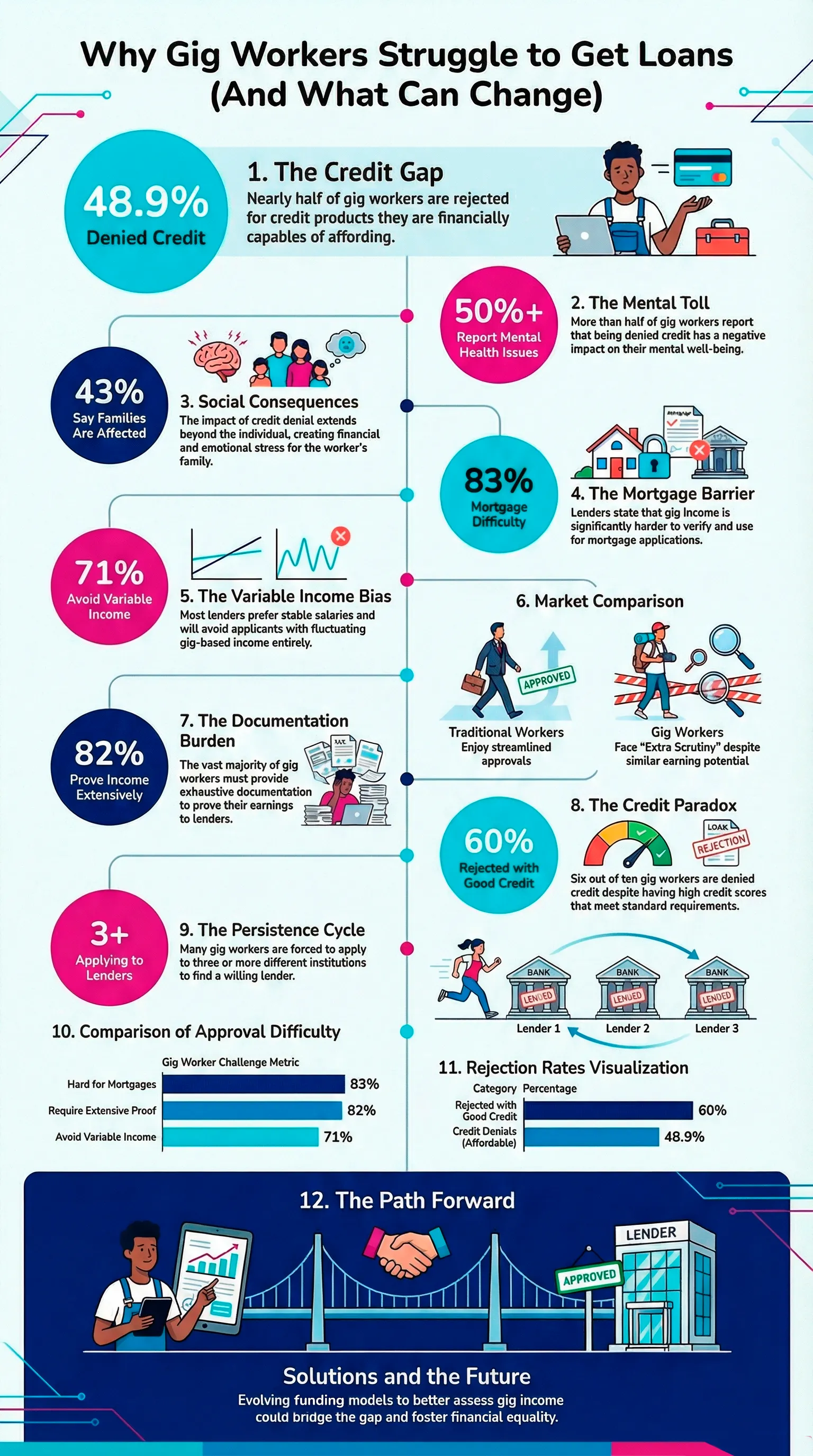
The Trends in Financial Access for 1099 Workers study, conducted by the employment data platform Argyle, found that 48.9% of 1099 workers have been turned down for things they know they can afford. And this, in turn, has caused over half of those denied to experience a negative hit on their mental health, and close to 43% report fallout for their families when the system locks them out.
While gig workers can earn significant amounts, the inconsistency in income can create uncertainty about future earning potential. This unpredictability makes it harder for lenders to assess whether you can sustain regular loan payments, especially in times of financial hardship or market downturns. Without a predictable income stream, lenders prefer to err on the side of caution, adding extra hurdles for gig workers when applying for loans.
Why the Extra Scrutiny?
According to Fannie Mae’s Mortgage Lender Sentiment Survey®, 83% of the senior mortgage executives surveyed said digital or variable gig income is difficult to use when it comes to mortgages, while 71% avoid variable income for the same reason.
Meanwhile, according to the Trends in Financial Access for 1099 Workers study, nearly 82% of 1099 workers are asked to verify their earnings for loans, housing, or other essentials, and over a third of these workers encounter difficulties in meeting the standards set by lenders or landlords. Moreover, a clear majority, 63.9% are willing to share pay stub information if it means proving their actual earnings.
In order to get a grasp of the money coming in, most lenders require more documentation to verify income than they would for a traditional employee. It’s not unusual for gig workers to be asked to provide years of tax returns and months of bank statements, along with a substantial amount of contracts, invoices, and proof of ongoing work. All of this is to compensate for the lack of the “steady employer” box that traditional workers can check off.
No “Stable Employer” Box to Tick
The main issue is that most gig workers lack the one thing lenders really trust: an established employer. In a traditional job, the employer assumes a certain level of risk by offering you a salary, and the lender can rest easy knowing you’re going to show up for work and get paid regularly. Gig workers, on the other hand, are often seen as independent contractors who may not have long-term commitment from clients. If work dries up, so does the income, and that leaves lenders uncertain about whether you can keep up with your loan payments.
It’s About Predictability
Lenders want predictability. They want to know that every month, without fail, you’ll be able to make your payments. If your income can go up or down depending on demand or clients, that’s a red flag.
Credit Scores and Debt-to-Income Ratios
Even if you have a good credit score and a reasonable debt-to-income ratio, gig income can still complicate things. According to the Rollee report, nearly 60% of gig workers have been rejected for loans despite solid credit scores. Most have to apply to three or more lenders just to get approved. Lenders often struggle with how to factor in variable income when calculating your financial stability. Your credit score might be great, but if your income fluctuates wildly, they might doubt your ability to maintain your financial commitments in the long run.
The Gig Economy’s Lack of Traditional Benefits
Another challenge is that gig workers usually don’t have the same benefits as traditional employees, like health insurance, retirement plans, or paid time off. This means gig workers are more vulnerable to financial setbacks, which increases their risk in the eyes of lenders. If you get sick or have an emergency, you might not be able to work for a while, and that would affect your ability to make consistent loan payments. Lenders see the lack of a safety net and view it as an added risk.
How Lenders Protect Themselves
In some cases, lenders may be willing to approve a loan for a gig worker, but they’ll usually charge a higher interest rate to offset the risk. Alternatively, they might require a larger down payment or collateral. For example, if you’re buying a home, they may ask for a significant amount of equity upfront to make up for the perceived risk of your income.
How Conventional Credit Tools Disadvantage Contractors
The backbone of most lending decisions remains the FICO score, a system designed for a workforce that clocks in and out with predictable paychecks. When your earnings fluctuate from month to month, it can be harder to stay on top of bills or make payments on time. Even a single late payment can hurt your credit, since payment history makes up the largest portion of most credit scoring models.
Additionally, many freelancers or independent contractors have limited credit histories or fewer active credit accounts, which can work against them in the eyes of lenders. With fewer data points to assess, credit agencies may interpret the limited activity as risk, even if you’re financially responsible. The system ultimately penalizes gig workers not for mismanaging their finances, but simply for earning money in nontraditional ways.
Credit scores alone don’t cut it for gig and freelance workers. Argyle’s study shows that over half of 1099 workers regularly check their scores, yet only about a third truly understand how those scores are calculated. More importantly, nearly 70% say employment records can do a better job of showing their ability to pay.
Moreover, a clear majority, with over 70% of gig workers, believe that financial service approvals should include other data points beyond credit scores. The bottom line is that relying solely on credit scores overlooks the complete financial picture of gig workers, thereby blocking access.
Reliance on High-Cost Credit

When banks refuse to lend, gig workers are often left with few choices. Some payday lenders, cash advance apps, and high-interest credit card companies are more than willing to fill the gap, but they do so at a steep price. The result is that gig workers become disproportionately reliant on credit options that come with sky-high fees, predatory terms, and repayment structures designed to trap borrowers in cycles of debt.
Over time, the consequences compound. The interest piles up, minimum payments barely make a dent, and financial stress becomes a constant. What started as a paperwork barrier becomes a full-blown debt spiral.
Fintech’s Answer for Gig Workers
Banks view irregular income as high risk, but fintech lenders see it as an opportunity. Fintech companies are pioneering new credit models that go beyond pay stubs and credit scores, tapping into the rich pool of data gig workers generate through apps, bank accounts, and digital savings. That said, fintech lenders offer products like cash advances and lines of credit that rely on real-time financial data rather than W-2 income proofs.
Policy and Regulatory Ideas to Reduce Bias
Underwriting guidelines would accept bank statements, app payout records, and digital savings data, which is viewed as diverse, and not just pay stubs.
Moreover, regulators can incentivize pilot programs for alternative scoring, support collaboration between banks and fintechs, and enforce fair rules for all loan products. Cities, nonprofits, and advocacy organizations need to pressure lenders and fund new credit products designed for flexible work arrangements. This is because systemic change requires balancing innovation with responsibility, ensuring that expanded access doesn’t compromise fairness.
Advocacy and Moving Forward
As the workforce continues to evolve, the tools used to assess creditworthiness must also evolve. Traditional credit models may not be built for today’s diverse income streams, but that doesn’t mean they can’t be reimagined.
Emerging credit models and smarter digital tools offer promising alternatives that look beyond the old “payroll-or-nothing” mindset. Instead of penalizing gig workers for having nontraditional income, these newer systems have the potential to reward consistency, responsibility, and long-term engagement across platforms.
Some believe that traits such as financial literacy, client retention, and platform reliability may serve as better indicators of creditworthiness than the presence of a single, steady paycheck. While the shift won’t happen overnight, there’s a real opportunity to level the playing field, and not just for gig workers, but for anyone outside the conventional employment mold.
The path forward requires collaboration. Gig workers can continue to push for transparency and better representation. Fintechs can continue to build tools that capture the entire financial picture. And policymakers have the power to reshape outdated regulations to reflect how people actually work and earn today.
Progress may be slow, but it’s happening. And with continued advocacy, innovation, and awareness, a more inclusive credit system is within reach, one that treats fair access not as a privilege tied to a job title, but as a fundamental financial right.
Disclaimer: Giggle Finance provides Revenue-Based Financing programs for business purposes only. Any mention of any loan product(s), consumer product(s), or other forms of financing is solely for marketing and educational content purposes and to help distinguish Giggle Finance’s product from other comparable financing options available in the markets.