

This bill aims to resolve conflicts between gig platforms, labor unions, and lawmakers about how to balance driver flexibility with fair compensation and basic protections. One core issue is that many drivers do all the work and expenses (fuel, vehicle maintenance, insurance) but have little leverage to negotiate.
In his remarks, Senator Dave Cortese, chair of the Senate Transportation Committee, said, “Many drivers take home as little as $9 an hour after expenses.”
Supporters like SEIU California call this bill a watershed moment—one of the largest expansions of private-sector collective bargaining rights in California’s history.
“Rideshare drivers need a stronger voice to stand up against poverty wages and poor working conditions. AB 1340 provides a statutory path toward a living wage by granting drivers the ability to unionize and bargain for fair pay and benefits,” the senator added.
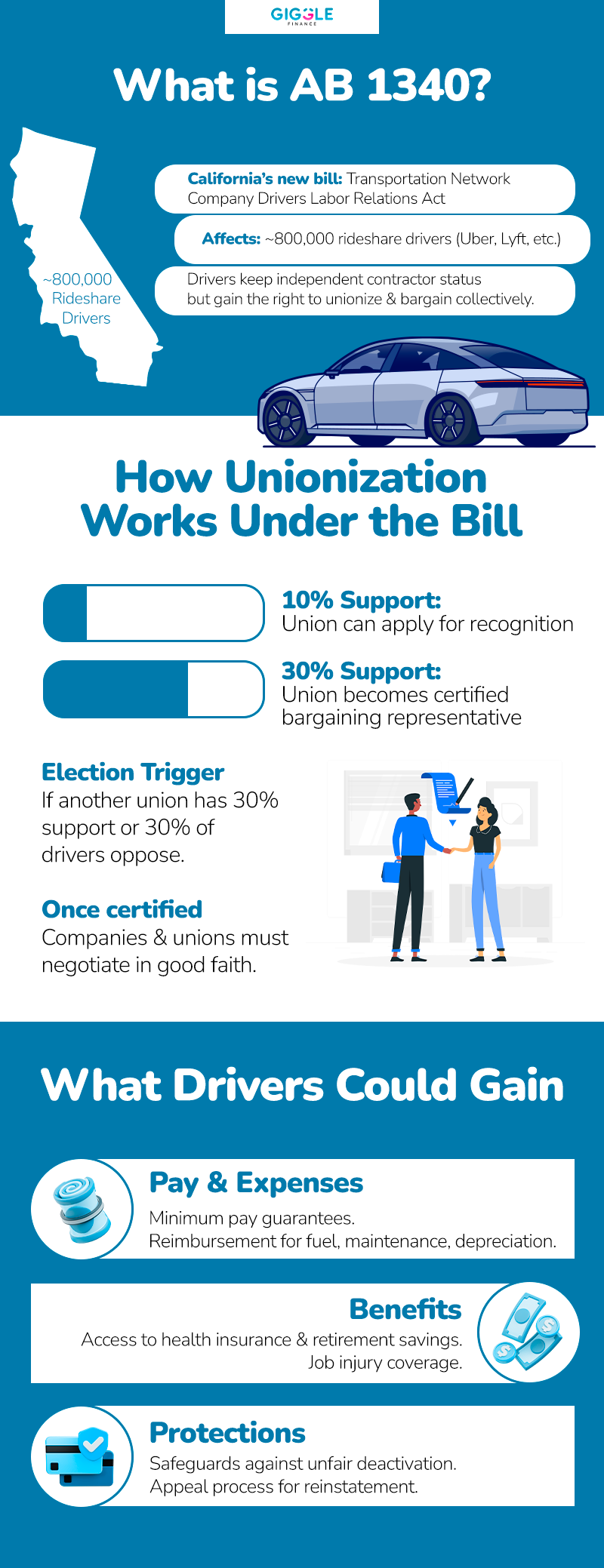
Key Features: New Paths to Collective Bargaining
Here’s what AB 1340 (Transportation Network Company Drivers Labor Relations Act) does and how it changes the process for rideshare drivers in California who want to organize:- Drivers can form or join “driver organizations” if they choose, and a union (or similar driver group) can seek state recognition to represent rideshare drivers.
- To get initial certification as a recognized driver bargaining organization, the group must show support (“proof of support”) from at least 10% of “active” drivers.
- To become the certified driver bargaining organization (i.e., the sole or official representative for collective bargaining), the support threshold is 30% of active drivers. If the organization hits 30% but less than a majority, or if there is opposition, the board may call a vote among active drivers.
- Once certified, this organization gains the right to bargain in good faith with companies like Uber and Lyft. That means the companies must negotiate terms like pay, benefits, and conditions, and can’t punish drivers for union involvement.
- The bill also sets up procedures for elections, decertification (if drivers decide they no longer want union representation), and protection against unfair labor practices.
- Importantly, AB 1340 keeps drivers classified as independent contractors; it doesn’t change their classification to employees. The law is designed to give them collective bargaining rights without reclassifying them.
Potential Gains for Drivers
Through collective bargaining, rideshare drivers may pursue improvements in three key areas:Pay and Expenses
Rideshare drivers may bargain to secure better minimum pay guarantees and reimbursement for vehicle-related expenses, such as gas, maintenance, and depreciation. This aspect has been a significant dispute because California law requires employers to cover work-related expenses for their employees, but not for independent contractors like rideshare drivers.Benefits
Drivers may also push for improved access to traditionally limited or unavailable benefits for gig workers. These include health insurance, retirement plans, and coverage for injuries sustained on the job that are not covered by regular auto insurance.Job Protections
They can also call out for protection against being deactivated, which could be permanent or temporary terminations, without just cause or an appeal process to challenge those decisions, as this can significantly impact their income and livelihood, and make it hard to keep up with inflation. Surveys show many drivers struggle with deactivation disputes. A report from the Action Center on Race and Economy found drivers averaged nearly eight attempts to regain accounts, with two-thirds saying they did not receive meaningful assistance from the companies.Challenges Ahead for Driver Unionization
While the law creates new opportunities, its effectiveness will depend on practical implementation. Key challenges can include:Statewide Organizing
One key challenge is that the union would represent all ride-hail drivers statewide, so organizers must secure support from drivers scattered throughout the state while on the road.Eligibility Rules
Only drivers considered “active,” or those in the top 50% by number of rides completed in the last six months, count toward the required support levels. However, Drivers with fewer than 20 rides in that period are excluded from the vote, narrowing the pool of eligible voters to those most involved.How This Deal Differs from Previous Labor Disputes
Labor debates over gig work in California have long centered on whether drivers should be classified as employees. In 2019, California updated its employment laws to tighten rules on when companies can classify workers as independent contractors. In response, a ballot measure, Proposition 22 (Prop 22), was introduced in 2020 to exempt drivers from these new rules. Prop 22 allowed drivers to remain independent contractors but explicitly barred them from unionizing or collectively bargaining over their pay, benefits, or work conditions.However, court rulings related to Prop 22 left room for the state Legislature to create a path for drivers to unionize. Therefore, lawmakers introduced AB 1340.
Ripple Effects: How Other States Are Responding
California is not alone in rethinking gig worker protections. If enacted, California would be the second state to allow rideshare drivers to unionize after Massachusetts. In Massachusetts, voters approved a ballot measure last November called Question 3: Unionization for Transportation Network Drivers. With nearly all precincts reporting, 53.9% of Massachusetts voters supported a new framework enabling drivers, who are generally classified as independent contractors by their companies, to organize and negotiate collectively over pay and benefits.Meanwhile, other states are also taking different approaches to improving conditions for gig workers. For example, Oregon lawmakers considered a bill this year, Senate Bill (SB) 1166, requiring rideshare companies to guarantee minimum pay rates, paid sick leave, and create protections against unfair driver deactivations. Similar laws have already been passed in states like Minnesota and Washington.
Beyond unionization and better pay, many states are experimenting with "portable benefits" or health and retirement plans that travel with workers from job to job. Several states with Republican-led legislatures, like Utah, Alabama, and Tennessee, have passed portable benefit laws recently.
Some states also show bipartisan support. Maryland and Pennsylvania’s Democratic governors have launched portable benefit pilot programs with companies like DoorDash, while Georgia’s Republican governor has also supported similar efforts. However, for wider bipartisan adoption, worker advocates must set aside disputes over whether gig workers are employees or independent contractors. For instance, unions opposed Wisconsin’s bill because it clearly states drivers are not employees under state law.
Looking Ahead: What Might Shift in the Gig Economy?
California’s new law may set the tone for national debates on gig work. But there are early questions that may need answers, such as:- How quickly will unions organize drivers under the new system?
- What will the first contracts look like regarding wages, benefits, and protections?
- How will companies adapt through policy changes, new pay structures, or lobbying in other states?
For drivers, the bill could mark the beginning of a new era, one in which collective bargaining is possible without sacrificing the flexibility of independent contracting.
Disclaimer: Giggle Finance provides Revenue-Based Financing programs for business purposes only. Any mention of any loan product(s), consumer product(s), or other forms of financing is solely for marketing and educational content purposes and to help distinguish Giggle Finance’s product from other comparable financing options available in the markets.