

On this page
Remote work changed how the world hires. What started as a short-term shift during the pandemic has turned into a permanent, borderless job market.
Today, U.S. freelancers and contractors no longer compete only with local peers but also with skilled professionals from every continent who offer similar services for lower rates. As a result, many U.S. gig workers are rethinking how they position their skills, set prices, and keep long-term clients.
Learning how this global shift works is the first step toward thriving in it. The data shows both challenges and opportunities for U.S. freelancers ready to compete on more than price.
Why Global Competition Is Rising
In just a few years, remote work shifted from an exception to a standard business practice. This change opened the door for millions of independent professionals worldwide, and it has reshaped how U.S. freelancers compete for work.
What Changed in the Marketplace
Remote-first work and the rise of online platforms have made cross-border hiring a normal part of business. Companies are no longer limited by geography when they need talent. They now look for skill, availability, and cost efficiency, regardless of location.
Remote Work and Platform Growth
When offices closed during the pandemic, businesses had to adapt quickly. Remote work became a necessity, and many discovered that it worked well. That experience changed hiring forever. Even after restrictions ended, most companies kept flexible or hybrid setups.
Freelance platforms helped cement that shift. Sites like Upwork, Fiverr, and Toptal have made it easy to find, vet, and pay talent in different countries. With just a few clicks, a company can now hire and manage teams in several time zones.
Lower Costs and More Global Talent
Global hiring also means access to a much wider range of rates. It allows clients to stretch budgets and cover more hours by hiring internationally. This global reach is changing the market for good. While cost competition creates pressure, it also pushes everyone to specialize, improve service quality, and offer unique value that goes beyond price.
How Global Marketplaces Changed Freelancing
Freelance platforms are the main reason this competition happens at scale. Platforms like Upwork, Freelancer.com, and Guru now have millions of users from more than 150 countries. They’ve turned a once-local industry into a worldwide economy of skills.
Easier Access for Clients and Freelancers
These marketplaces create instant access for both clients and workers. Small business owners can post a project in the morning and receive proposals from several time zones by noon. That means more opportunities but also faster decision cycles, where clients often choose based on cost and availability first.
At the same time, platforms help new freelancers enter the global market quickly. Account verification, portfolio uploads, and skill tests remove many barriers that once limited access to cross-border work.
Platform Systems Affect Visibility
Algorithms match clients with contractors based on response times, reviews, and completed projects. Workers who maintain high ratings and quick replies tend to appear more often in search results.
This system rewards reliability but also allows new freelancers from abroad to rise fast if they perform well. For U.S. freelancers, it means staying active, responsive, and consistent is key to maintaining visibility.
In short, global platforms have made freelancing more efficient but also more competitive. They’ve expanded the client pool while raising the expectations for quality and speed.
The Numbers: U.S. vs. International Contractor Rates
Global competition is most visible when you look at actual pay rates. In 2025, these differences are shaping how clients hire and how U.S. contractors price their work.
2025 Benchmark Rates by Role and Country
Rates vary widely, and price gaps continue to drive competition. Understanding where those gaps are can help U.S. freelancers decide how to position their skills and find markets that value their expertise.
Developers and Designers
Technical and creative professionals earn some of the highest rates in the gig economy, but global averages show big differences.
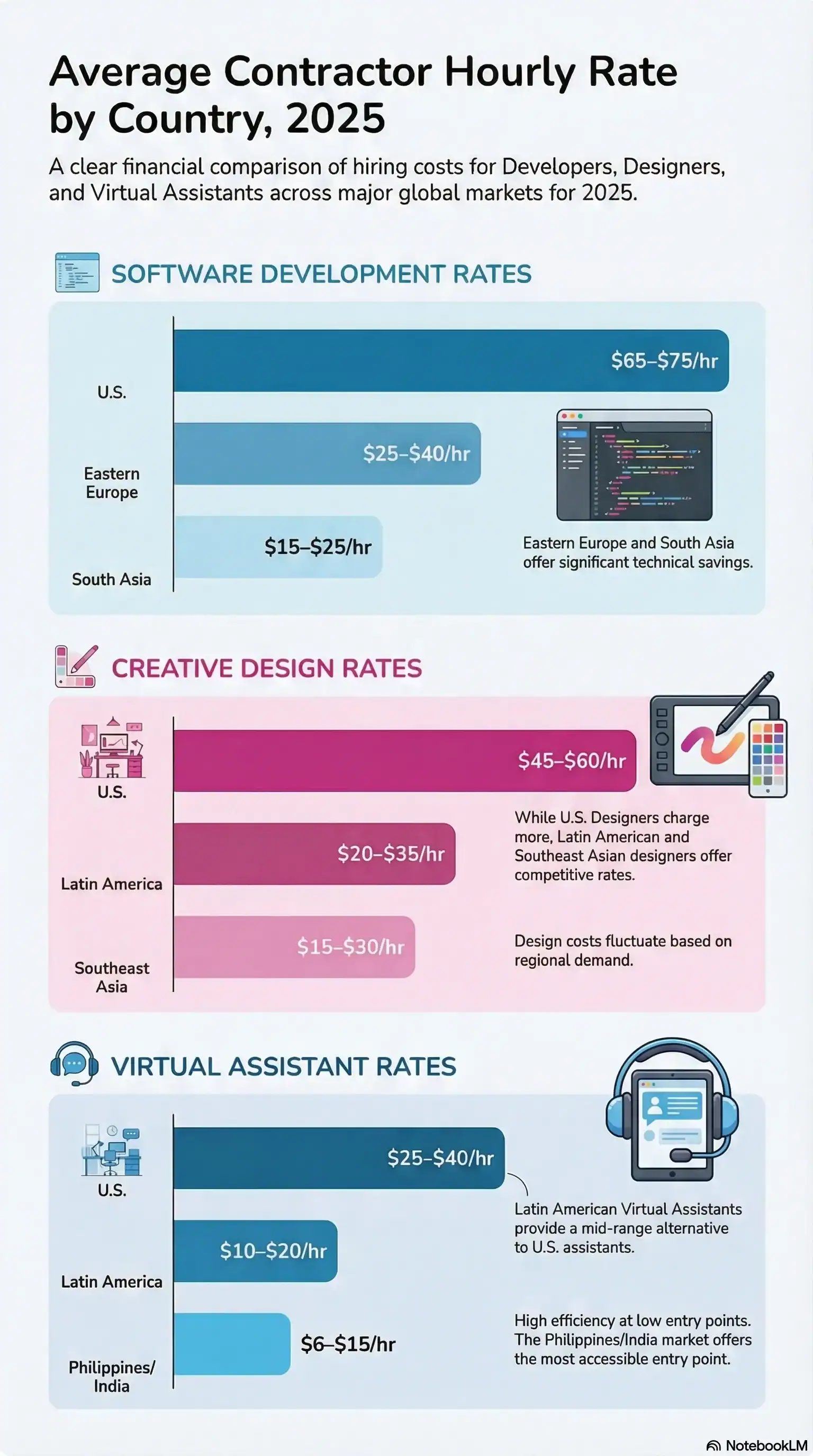
According to Remotepass’s 2025 Global Contractor Rates Report, developers in the U.S. charge about $65–$75 per hour on average. In Eastern Europe, developers typically charge $25–$40, while in South Asia, rates fall between $15–$25.
For designers, the U.S. average is around $45–$60 per hour, compared to $20–$35 in Latin America and $15–$30 in Southeast Asia.
Experience also changes the gap. Senior U.S. developers with specialized skills, such as AI or cybersecurity, can earn $100 per hour or more, while entry-level global freelancers often start at half that rate.
Virtual Assistants and Support Roles
In the U.S., virtual assistants (VAs) typically charge $25–$40 per hour, while counterparts in the Philippines or India often charge between $6–$15 per hour. Latin American professionals usually fall somewhere in between at $10–$20.
These gaps reflect skill levels but also local cost-of-living differences. For many international freelancers, a lower hourly rate compared to their U.S. counterparts can still provide a comfortable income. For U.S. workers, competing directly on price in these roles is difficult because of the higher cost-of-living in the country.
Specialized and Knowledge-Based Work
Specialized fields like finance consulting, UX strategy, and technical writing continue to pay well for U.S. workers. These roles require deeper knowledge, industry experience, or understanding of U.S. regulations, which are areas that global talent can’t always replicate easily.
What This Means for U.S. Freelancers
This global shift in competition is forcing freelancers to adapt. For many U.S. gig workers, these rate gaps can feel discouraging at first, but they also highlight new ways to stand out and build long-term stability.
Pricing Pressure and Project Mix
Global competition has tightened pricing in routine and entry-level work. Clients now compare dozens of bids from different countries, making it harder for U.S. freelancers to charge higher rates for basic services.
However, this pressure is strongest in areas where tasks are easy to repeat and deliver remotely, such as data entry or administrative work. Freelancers who specialize, communicate clearly, and deliver consistent quality still earn well because clients value trust and dependability.
Many successful freelancers respond to global competition by adjusting their project mix. Instead of accepting every offer, they focus on higher-value clients or long-term retainers where their expertise matters more than hourly cost. This shift helps maintain a steady income even when average global rates drop.
Commoditized vs. Specialized Work
The more unique the skill, the stronger the pricing power. Technical, creative, or regulated work such as financial writing, UX design, or compliance consulting continues to favor U.S. freelancers who understand local laws, taxes, or consumer trends.
Clients are also willing to pay more for freelancers who make their jobs easier to manage. That might mean being available during U.S. business hours, managing communication professionally, or offering a polished client experience.
How to Stay Competitive: Strategies That Work
The global freelance market can feel crowded, but U.S. freelancers have a strong advantage: experience with local clients, communication standards, and a deep understanding of U.S. business culture.
Positioning and Specialization
Freelancers who focus on a niche can stand out faster. Instead of trying to serve everyone, it helps to identify what makes your work different and who benefits most from it.
Niche Down and Productize
A clear niche helps clients understand your value right away and reduces competition from global bidders. For example, a designer who focuses on real estate brands or a writer who specializes in finance content can attract clients faster than generalists.
Productizing your service like offering set packages or fixed project types also builds trust and makes pricing easier for clients to compare.
Move Up the Value Chain
U.S. freelancers can charge more by offering services that involve strategy, planning, or problem-solving instead of only task execution. For instance, a virtual assistant can evolve into an operations coordinator, and a developer can expand into system consulting or workflow automation.
These steps add more value and make it less likely that clients compare your rates to lower-cost global talent. It also opens doors to long-term contracts and repeat business from clients who see you as a trusted partner rather than a one-time hire.
Trust, Reputation, and Client Experience
Clients prefer working with people who are reliable, responsive, and easy to communicate with. As such, a strong reputation is often more powerful than the lowest bid.
Show Proof of Quality
Building a small portfolio of real projects, before-and-after examples, or short case studies helps you prove your value quickly. Even new freelancers can do this by completing small test projects or volunteering for short-term work in their target niche.
Once you gather feedback, display it clearly on your profile or website. Positive reviews and examples of measurable outcomes often matter more to clients than where you are located.
Communicate Clearly and Consistently
Responding on time, confirming deadlines, and giving regular progress updates create trust. Keeping communication professional and predictable also helps justify higher rates.
Simple steps like summarizing meeting notes or sending a weekly update can set you apart from competitors who focus only on task delivery.
Deliver a Smooth Client Experience
Sharing your process early, such as timelines, revision limits, and payment terms, avoids confusion later.
How you handle your workflow affects your reputation. Freelancers who manage projects well often receive better reviews and repeat work. Over time, that builds a stable income base that isn’t affected by global price fluctuations.
Smart Pricing for U.S. Talent
Competing on cost alone is difficult, so the goal is to build a pricing approach that reflects skill, reliability, and client experience.
Use Tiered Offers and Packages
Instead of a single hourly rate, offer tiered packages such as a basic, standard, and premium version of your service. For example, a social media manager could offer a basic package with five posts, a standard package with monthly strategy and analytics, and a premium plan with paid ad management.
This setup allows clients with different budgets to choose what works for them while keeping your pricing consistent. It also helps you highlight the extra value you provide beyond deliverables.
Charge for Outcomes, Not Just Hours
Outcome-based pricing rewards efficiency and shows clients that you care about their goals. For instance, a web designer can price by the number of pages or site conversions instead of hourly work.
This approach often leads to better pay and reduces the temptation to compete purely on hourly rate. It positions you as a partner focused on business results, which appeals to clients looking for reliability and measurable success.
Adjust Rates with Confidence
It’s common for freelancers to hesitate when raising rates, especially when facing international competition. However, rates should grow with experience, proven results, and increased demand.
To stay competitive, review your pricing at least once or twice a year and update it when you add new skills or achieve consistent positive feedback. If clients push back, you can explain that your rates reflect quality, speed, and accountability.
Three Ways to Win More U.S. Clients
Competing globally does not mean giving up local advantages. U.S. freelancers can still win strong, long-term clients by focusing on what makes their work reliable, relatable, and easy to manage.
Simple Moves You Can Apply This Week
Target U.S.-Based Clients
Many businesses prefer hiring freelancers who understand local communication styles, time zones, and tax rules. Highlight these strengths in your profiles and proposals.
To find more U.S. clients, use search filters on freelance platforms or reach out directly through LinkedIn. You can also ask satisfied clients for referrals within their network.
Offer Value Beyond Deliverables
Adding value can be as simple as sending organized files, providing clear handoff instructions, or sharing quick tips that improve the client’s workflow.
Small touches, such as a follow-up email after project completion or a performance summary, can lead to repeat work. These actions show reliability and care—qualities that often matter more than price when clients decide who to hire again.
Stay Visible and Consistent Online
Clients often choose freelancers who are active and easy to find. Keep your online profiles updated with recent projects, clear descriptions, and fresh samples, and respond quickly to messages and job posts to show professionalism.
Posting helpful content on LinkedIn or sharing your expertise in online groups can also attract potential clients. Visibility builds trust, and consistency helps you stay top of mind when opportunities appear.
Risks and Opportunities Ahead
The global freelance market will keep expanding, and that brings both challenges and rewards. For U.S. freelancers, understanding what’s changing helps you make smarter decisions about pricing, skill growth, and client relationships.
Risks
Lower Pay in Common Jobs
As more international freelancers join the market, basic services such as data entry, design, and administrative support may continue to see lower prices. A race to the bottom on cost can erode earnings and make income increasingly unpredictable.
Fast-Changing Technology
AI tools and automation may also replace some repetitive freelance tasks. Therefore, staying flexible and learning new tools can help freelancers remain valuable as technology evolves.
Opportunities
More Clients Around the World
Freelancers can now work with companies anywhere in the world, using global platforms to find clients who value specific skills, even in small niche markets that didn’t exist locally.
Higher Pay for Specialized Work
Clients increasingly seek freelancers who can manage strategy, communication, and results. Offering quality service, local knowledge, and strong collaboration skills helps U.S. workers stand out and charge fairly for their time.
Conclusion
Global competition is now part of everyday freelance life, but it doesn’t have to be a setback. For gig workers in the U.S., this shift is a chance to grow, specialize, and reach new clients.
And the most successful ones focus on quality, trust, and long-term value. Competing globally starts with confidence in your skills and the ability to show clients why working with you is worth it.