
On this page
The gig economy has grown into a cross-generational movement that’s reshaping how Americans earn a living. From Gen Z freelancers building experience on digital platforms to Boomers driving part-time for extra retirement income, people of all ages are taking part. But participation looks very different depending on the generation—who’s most active, how much they earn, and why they turn to gig work varies widely.
Recent surveys show that Millennials and Gen Z make up the largest share of gig workers, while Gen X is becoming a leader in higher-earning independent roles. Boomers remain steady contributors, often motivated by the flexibility and supplemental income that gig work provides.
This report explores participation, earnings, and motivations across generations and considers how the balance of gig work could shift over the next five years.
Who’s in the Driver’s Seat? Generational Participation, at a Glance
Generational divides in the gig economy influence how often people work gigs, which platforms they choose, and why they take on gig work. Current data show a clear pattern: younger workers are in the majority, Gen X is growing in mid-career independent roles, and Boomers tend to use gigs mainly for supplemental income.
Gig Participation by Age
Younger adults are far more likely to do gig work than older generations. In the Federal Reserve’s 2024 SHED report, 26% of adults ages 18–29 said they had done gig work in the past month, compared to 12% of those 60 and older. This difference reflects both economic factors and greater comfort with technology-based platforms.
Side Hustles Across Generations
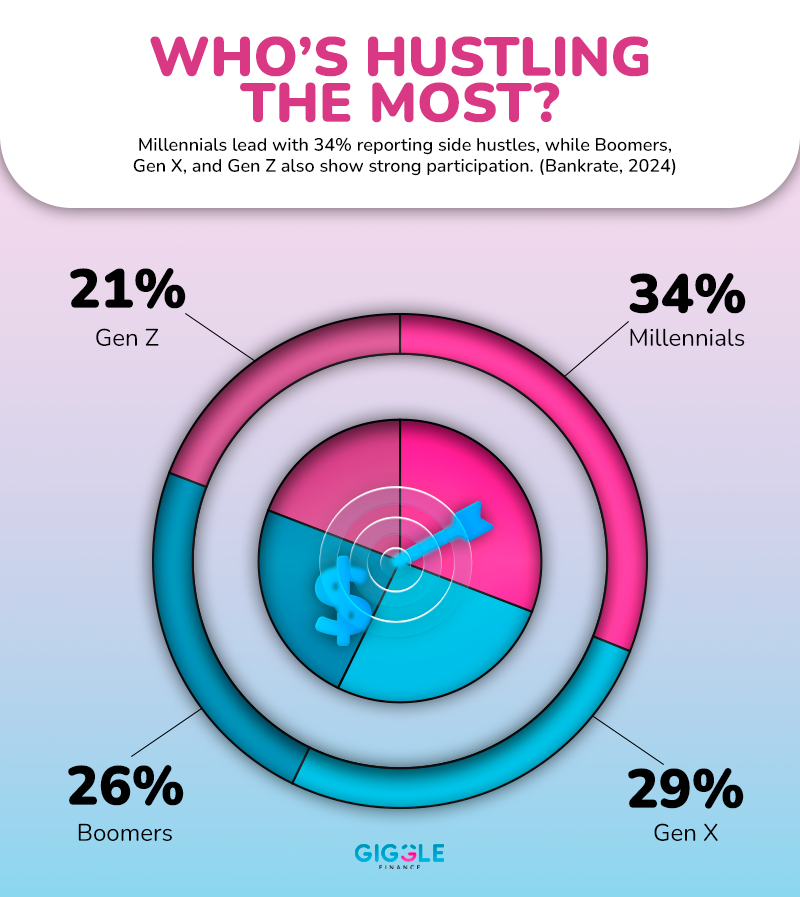
Gig work often shows up as a side hustle alongside a traditional job. A 2024 Bankrate survey found that 34% of Millennials report having a side hustle, followed by 29% of Gen X, 26% of Boomers, and 21% of Gen Z.
Millennials stand out as the group most likely to balance full-time employment with extra earnings. Younger workers often use side hustles to cover their day-to-day expenses, while older workers tend to use them to supplement their savings or retirement funds.
The Changing Face of Independence
MBO Partners’ most recent research found that Millennials and Gen Z together now make up 59% of the independent workforce. Earlier reports put Gen X at around 29%, but the latest data shows younger workers are taking a larger share.
The number of full-time independent workers also increased to 27.7 million in 2024, a rise of 6.5% from the previous year.
What They Earn: Comparing Earnings Signals by Generation
Earnings in the gig economy vary widely. Some workers make a few hundred dollars each month, while others reach six-figure incomes through independent careers. Generational differences shape not only how much people earn but also how steady that income feels and where the highest earners are found.
Income Benchmarks and Stability
Irregular pay is one of the biggest challenges for gig workers. According to the Federal Reserve’s 2024 survey, 52% of gig workers reported inconsistent income, and 42% said they wished they had access to benefits such as health insurance. Younger workers, especially Gen Z and Millennials, feel this instability most since they are more likely to depend on app-based platforms.
Still, many earn meaningful income through consistent gig work. TransUnion’s 2024 Gig Economy Report found that among workers who rely on gigs as their primary income, 36% of Millennials and 21% of Gen Z earned more than $5,000 in a recent reporting period. While these figures do not represent annual salaries, they highlight that younger workers are capable of generating substantial earnings in short timeframes.
Where the Higher Earners Are
Income volatility is common at the entry level, but mid-career workers tell a different story. MBO Partners’ 2025 research reported that the number of independent workers making $100,000 or more annually reached 5.6 million. Much of this growth comes from Millennials and Gen X, who pair professional experience with the independence of self-employment.
This group includes consultants, contractors, freelancers, and other professionals, not just app-based drivers or delivery workers. The trend suggests that career maturity often translates into higher earnings within the independent workforce.
Averages Can Be Misleading
Even with rising success stories, average earnings often paint an incomplete picture. For younger workers, especially Gen Z, income is frequently tied to creator and content-driven platforms.
The Bank of America Institute’s 2024 analysis found that while participation in the creator economy is growing, most individual earnings fall far below full-time wages. A small share of top creators earn disproportionately high incomes, which can skew public perception and raise unrealistic expectations.
Generational Divide in Earnings
Overall, Millennials and Gen X are steadily building sustainable, higher-paying independent careers. In contrast, many Gen Z workers and Boomers use gig work as a supplement to traditional income rather than a full replacement.
Why Each Generation Turns to Gig Work
The reasons people take on gig work vary just as much as the workers themselves. For some, it’s a financial lifeline. For others, it’s a way to gain independence, test new career paths, or ease into retirement. Data show that motivations are heavily shaped by age and life stage.
Gen Z and Millennials: Flexibility, Cash Flow, and Career Building
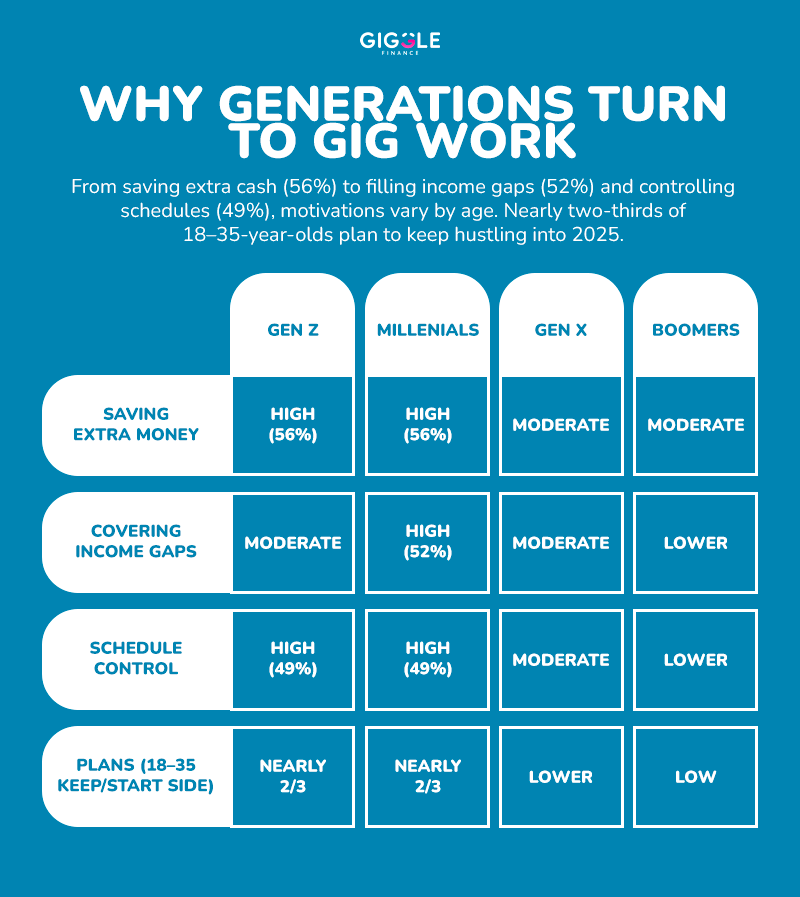
For younger workers, gigs are both an opportunity and a necessity. According to the Pew Research Center, the top reasons include saving extra money (56%), covering income gaps (52%), and maintaining schedule control (49%). Gen Z tends to prefer digital-first platforms that allow them to fit work around school or early career jobs, while Millennials often use gigs to offset rising living costs or strengthen their household finances.
Many also see side hustles as a long-term plan. An Intuit survey found that nearly two-thirds of workers aged 18–35 expect to keep side hustles into 2025, showing that gig work is becoming part of career strategy, not just a temporary solution. Younger workers are especially open to skill-based gigs, like writing, design, or tutoring, that can double as springboards into independent careers.
The biggest challenge for this group is uneven earnings, which makes managing cash-flow gaps between gigs essential for sustainability.
Gen X: Stability, Control, and Mid-Career Balance
Generation X approaches gig work differently. For them, it’s less about testing options and more about strategic career management. MBO Partners’ 2023 report notes that 29% of independents are Gen X, reflecting a steady increase in their share of the gig economy.
Mid-career workers often use gigs to diversify income, buffer against corporate shifts, or prepare for semi-retirement. Unlike younger groups who may juggle multiple smaller gigs, Gen X typically leans on consulting, contracting, or project-based work tied to their professional expertise. For many, it’s a deliberate approach to maintaining stability while gaining more control over their work and life.
Boomers: Income, Flexibility, and Purpose in Retirement
For Baby Boomers, gig work is less about building a career and more about staying active while supplementing their retirement income. The Federal Reserve’s 2024 report shows that 12% of adults aged 60 and older continue to participate in gig work. Typical roles include tutoring, caregiving, and rideshare driving—jobs that allow flexibility around family and lifestyle needs.
Beyond finances, many Boomers value the purpose and social connection gig work provides. It offers a way to stay engaged with their communities while enjoying the freedom to choose when and how much to work.
That said, participation is gradually declining as more people transition fully into retirement. For those who continue, gigs remain a blend of financial relief and personal fulfillment.
What’s Ahead: A 5-Year Generational Outlook
The gig economy is evolving quickly, and the next five years will highlight sharper generational divides. Younger workers are expected to keep driving participation, Gen X will strengthen its role in higher-earning, independent work, and Boomers will steadily step back. Here’s how the future is shaping up.
Participation Forecast
Gen Z and Millennials will continue to be the largest groups of gig workers. TransUnion’s 2024 Gig Economy Report reveals that nearly half of Millennials are already working in platform-based gigs, and their share is projected to increase as younger cohorts pursue flexible income and career-building opportunities. Intuit/QuickBooks surveys also suggest that nearly two-thirds of 18–35-year-olds plan to start or continue side hustles into 2025, signaling strong momentum among younger workers.
Gen X participation is expected to grow gradually. MBO Partners reports that 29% of independents are already Gen X, and this number is expected to rise as mid-career professionals transition into consulting, freelancing, or project-based roles, often in response to corporate layoffs or career changes.
Boomers, meanwhile, will likely see declining participation. While some will stay active for supplemental income or social connection, many are moving into full retirement. Their presence in the gig economy will likely shrink, even as their motivations remain largely unchanged.
Earnings Outlook
Earnings are expected to reflect not just participation but also experience and type of gig. At the top end, MBO Partners projects that 5.6 million independent workers already earn $100,000 or more annually, with Millennials and Gen X leading this group. Over the next five years, Gen X and older Millennials are positioned to dominate high-paying independent work, particularly in professional services, consulting, and tech-driven roles.
For Gen Z, the outlook is mixed. Many will continue to pursue creator economy gigs and app-based platforms, but research from the Bank of America Institute shows that average creator earnings fall far below full-time wages. This suggests that while a small number of younger workers may transition into high earnings, most will likely continue to use gig work as supplemental income.
Boomers who remain active in gig work are likely to focus on low-barrier, part-time opportunities like delivery, tutoring, or caregiving. Their income contributions will be modest, but important for individuals who rely on flexible earnings to offset retirement savings gaps.
Policy & Platform Shifts
The future of gig work will also depend heavily on how platforms and policymakers respond to worker needs. According to the Federal Reserve’s 2024 survey, 55% of gig workers value flexibility, but only 35% feel their gigs support a healthy work-life balance. That gap leaves room for platforms to improve retention through faster payouts, better scheduling tools, or pilot programs for limited benefits.
On the policy front, portable benefits and stronger protections for independent workers are gaining traction. If implemented, these measures would be especially impactful for Gen X and Boomers, who are more focused on health and retirement security, while still helping younger workers stabilize their income.
What Gig Workers Can Do Now
Generational differences shape not only why people join the gig economy but also the best ways to make it sustainable. Here’s how each age group can maximize opportunities while minimizing risks.
Gen Z & Millennials: Build Skills and Steady Income
For younger workers, gig work often fills income gaps while offering flexibility. The challenge is unpredictable pay. Strategies like using cash-flow tools, setting aside a portion of each payment, and budgeting for irregular income can help create financial stability. At the same time, building digital skills, whether in design, tutoring, or content creation, turns side hustles into long-term career assets with growth potential.
Gen X: Protect Stability and Diversify Earnings
Midlife workers increasingly rely on gigs to maintain independence and control. The biggest risk is relying too heavily on a single income stream. Diversifying across consulting, project-based contracts, and part-time platforms spreads out the risk and creates consistency. Accessing alternative funding options can also provide a cushion during slower seasons, helping Gen X strike a balance between stability and flexibility.
Boomers: Prioritize Flexibility and Low-Strain Gigs
For Boomers, gig work is less about career building and more about supplementing retirement savings while staying engaged. Choosing physically manageable gigs, like tutoring, caregiving, or part-time delivery, keeps work purposeful without added stress. Using simple, user-friendly platforms and tapping into support resources can also help make the experience smoother and more rewarding.
Conclusion
The gig economy has become a core part of the U.S. workforce, with every generation participating for different reasons. Gen Z and Millennials are leading the way, turning to gigs for flexibility, skill-building, and extra income. Gen X is establishing itself in higher-earning independent work, while Boomers stay active by supplementing retirement and engaging in part-time opportunities.
Looking ahead, these generational patterns will become even more distinct. Younger workers are set to expand their share of platform-based gigs, Gen X will remain a key force in professional freelancing, and Boomers will gradually scale back as many shift into full retirement. Together, these shifts will continue to shape the role of gig work within the broader U.S. economy.