On this page
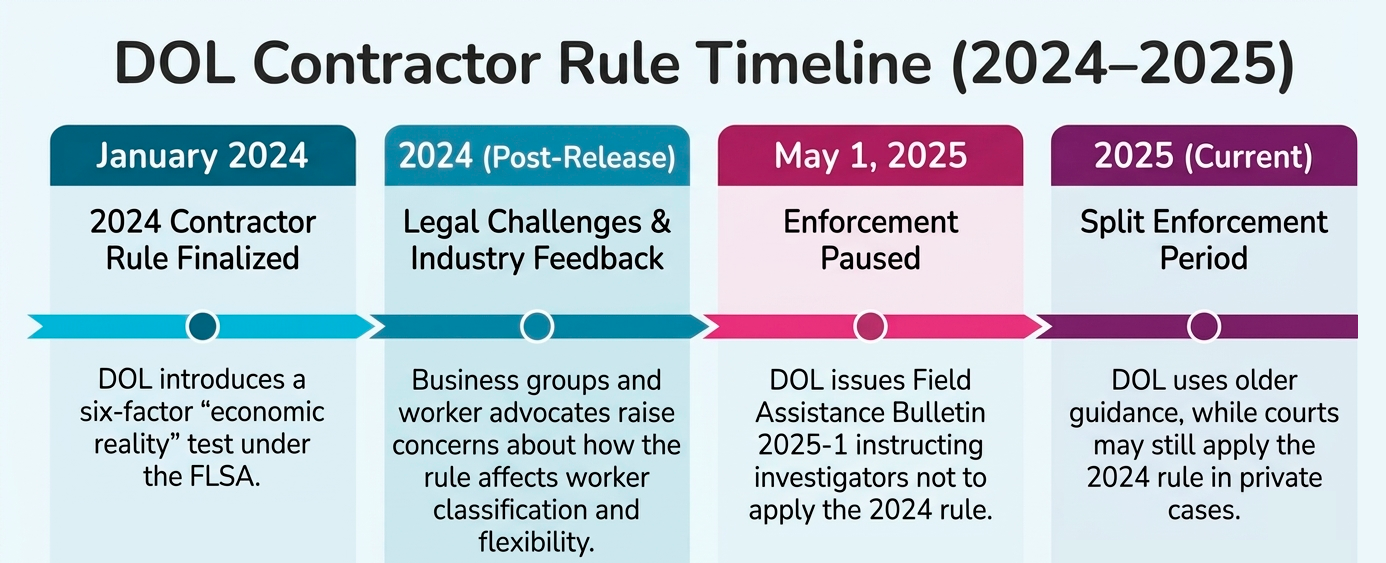
On May 1, 2025, the U.S. Department of Labor (DOL) announced that it would no longer apply the 2024 independent contractor rule in its enforcement cases. This move marks a significant shift in how worker classification is evaluated under the Fair Labor Standards Act (FLSA). The 2024 rule, which introduced a six-factor “economic reality” test, remains legally in place but is now under agency review following legal challenges and feedback from multiple industries.
For gig workers and the self-employed, the decision brings both clarity and confusion. While federal enforcement is on hold, private lawsuits can still rely on the 2024 framework, creating uneven standards across the workforce. This creates a transition period that affects how independent contractors are defined, protected, and paid in today’s gig economy.
What Changed: Understanding the DOL’s Contractor Rule Reversal
The 2024 Rule and Its Six-Factor Test
In January 2024, the U.S. Department of Labor finalized a new rule redefining how to determine whether a worker is an employee or an independent contractor under the FLSA. Known as the “economic reality” test, this framework evaluates six core factors:
- The worker’s opportunity for profit or loss
- Investments by the worker and the employer
- The degree of permanence in the work relationship
- The nature and degree of control over work
- The extent to which the work is integral to the business
- The worker’s skill and initiative
The rule replaced the 2021 version that emphasized two primary factors, control and profit opportunity, broadening the lens for assessing worker status. The DOL argued the 2024 approach better reflected long-standing judicial precedent and worker realities in the modern economy, including gig and freelance labor.
The May 1, 2025 Field Assistance Bulletin (FAB 2025-1)
Then, on May 1, 2025, the DOL issued Field Assistance Bulletin No. 2025-1, instructing its investigators not to apply the 2024 rule in enforcement actions while the agency re-examines its policy. In practice, this means that the DOL enforcement staff will revert to earlier guidance, notably Fact Sheet #13 and Opinion Letter FLSA2019-6, when evaluating whether workers are employees or independent contractors for now.
The agency cited legal challenges and stakeholder concerns about how the 2024 rule affected flexible work arrangements. Importantly, this pause does not repeal the rule, but halts its use in DOL investigations.
Why the DOL Paused Enforcement
The DOL’s decision was largely driven by a combination of ongoing court disputes, industry feedback, and the agency’s own review of policy consistency. Business associations, including the U.S. Chamber of Commerce and major gig platforms, argued that the 2024 rule was overly broad, increasing the risk of misclassification claims and operational costs. At the same time, worker advocacy groups contended that the rule did not go far enough to ensure fair pay and benefits for contractors.
The DOL indicated it would use this decision to “reevaluate and clarify” how classification should align with modern employment structures and prevent inconsistent enforcement. Until a new rulemaking process concludes, enforcement investigators will rely on earlier interpretations rooted in decades-old FLSA precedent.
Why It Matters: The Immediate Impact on Gig Workers

From income stability to worker protections, the pause has created both opportunities and uncertainties in the growing gig economy.
What the Pause Means for Workers
While the 2024 independent contractor rule technically remains in place, investigators will not apply it, leaving millions of gig workers and self-employed professionals uncertain about which definition governs their rights.
This matters because how someone is classified determines whether they qualify for minimum wage, overtime pay, and benefit protections under the FLSA. Moreover, a gig worker’s employment status may now depend more on platform policies or court decisions than on a single federal rule, as well as where they live or who enforces the rule.
Legal analysts warn that this inconsistency may encourage more lawsuits as workers and companies test the limits of contractor classification in 2025.
Short-Term Effects on Pay and Protections
The short-term impact of the DOL’s pause is mixed. On one hand, gig platforms gain temporary relief from stricter enforcement, allowing them to continue operating flexible, contract-based models. On the other hand, workers lose clarity about their rights and protections.
According to the Federal Reserve’s Report on the Economic Well-Being of U.S. Households (2024), roughly 26% of adults engage in gig work, and about half of those rely on it as a main source of income. Even when labeled as independent contractors, gig workers still absorb business costs such as fuel, equipment, and self-employment taxes without guaranteed benefits.
Also, the unclear classification means unpredictable access to benefits, like overtime pay or employer contributions, and may also delay potential improvements to wage security and labor protections.
How Gig Workers Can Protect Themselves
While the DOL reviews its rule, gig workers can take steps to safeguard their independence and financial stability. Staying proactive can reduce risks tied to income gaps or future reclassification.
Stay Organized and Document Everything
Clear documentation, such as contracts, invoices, and records of multiple clients, helps protect your independence. These materials demonstrate legitimate self-employed status if questions or disputes arise.
Plan for Financial Stability
Experts recommend setting aside money for taxes, healthcare, and emergencies to offset unpredictable income. Using tools like automatic savings or cash-flow apps can also help manage periods between gigs.
Stay Updated on Labor Laws
Staying informed helps you avoid misclassification issues and stay compliant when working with multiple clients or platforms. That said, independent professionals should keep an eye on both federal and state-level updates. Several states, like California and Massachusetts, maintain stricter standards that continue to apply regardless of DOL enforcement.
Public vs. Private Enforcement: What Still Applies
The biggest difference now lies between public enforcement (actions by the government) and private lawsuits (cases filed by workers or employers). Understanding how each works helps gig workers and small businesses know what protections still apply and where the risks remain during this period.
How Public Enforcement Works
Public enforcement happens when the DOL investigates whether a business is following labor laws. Since May 2025, DOL investigators have been told not to use the 2024 rule during these checks.
What This Means in Practice
For now, DOL staff will rely on older guidance, like Fact Sheet #13 and a 2019 opinion letter, to decide if a worker is an employee or contractor. This means fewer investigations under the new six-factor rule and less immediate pressure on gig platforms. However, the DOL can still step in if it believes a business is clearly misclassifying workers under earlier standards.
What Private Enforcement Means
Private enforcement refers to lawsuits or claims brought by individuals rather than the government. This includes workers who believe they’ve been misclassified or unpaid under the Fair Labor Standards Act.
Workers Can Still File Lawsuits
Even though the DOL has paused enforcement, the 2024 rule still exists, meaning private attorneys and courts can continue using it. For gig workers, this means the rule can still protect them in court even if the DOL isn’t currently enforcing it. Meanwhile, companies still need to focus on compliance, as lawsuits may continue even without federal involvement.
What to Expect Moving Forward
Until new guidance is released, businesses will face fewer audits from the DOL, but they’re still open to lawsuits. The result is a complicated middle ground where the same rule exists but is enforced differently depending on who brings the case. Knowing that distinction helps both sides stay cautious while the government reviews its next steps.
Implications for Platforms and Small Businesses
The move also changes how large gig platforms manage contractor relationships. It raises new questions about how to stay compliant while keeping operations flexible for small businesses.
How Gig Platforms Are Reacting
Gig platforms were among the first to welcome the decision. Companies that depend on flexible, on-demand workers, such as rideshare, delivery, and freelance platforms, see this as a short-term relief from regulatory pressure. Without active enforcement of the 2024 rule, these businesses can continue classifying most of their workers as independent contractors.
However, experts note that the pause should not be mistaken for a green light to ignore compliance. Platforms still face the risk of lawsuits and state-level challenges. California, Massachusetts, and New Jersey, for example, continue enforcing stricter worker classification tests. Furthermore, many companies are using this period to review policies, strengthen contracts, and train management teams to minimize misclassification risks.
Compliance Challenges for Small Businesses
For smaller employers that work with contractors, the DOL’s reversal can feel confusing. Without clear federal guidance, it becomes harder to know which test applies and how to classify workers properly.
Small businesses often hire freelancers for services like marketing, bookkeeping, or delivery. To stay compliant, they should document work terms clearly, define project-based scopes, and avoid controlling when or how contractors complete their tasks day to day. Maintaining evidence of a genuine business-to-business relationship, such as separate invoices and tax forms, also helps establish proper classification.
The key is consistency. If a worker functions like an employee, they must be treated and paid like one. But if they run an independent business, small employers should keep detailed records to support that relationship.
Long-Term Strategy: Preparing for Future Rule Changes
Most legal experts expect the DOL to introduce a revised rule within the next year. That means businesses and platforms should prepare early, rather than waiting for another sudden policy shift and risking costly issues.
Companies can use this time to run internal audits, consult employment attorneys, and adopt digital tools that track contractor activity more transparently. On the other hand, this serves as a chance for gig platforms to rebuild trust by improving pay transparency, communication, and worker protections voluntarily.
What’s Next: Outlook for 2025 and Beyond
The next year will likely bring new rules, ongoing court cases, and policy debates that could again reshape what it means to be a contractor or an employee.
DOL’s Next Steps and Possible Rulemaking
Since the current situation is only a review period, the DOL plans to collect feedback and may propose a new version of the contractor rule in late 2025. Early reports suggest that the agency could combine parts of the 2024 rule with older guidance to form a more balanced approach. Once the new proposal is released, there will likely be another round of public comments and reviews before it becomes official.
Role of Congress and the Courts
Congress and the federal courts also have a major role to play in shaping the future of gig work. Several lawmakers have already called for a clearer national standard that prevents confusion between federal and state laws.
Multiple lawsuits challenging or defending the 2024 rule are still active. Courts could influence how the next rule is written, especially if judges issue decisions that favor either a stricter or looser definition of contractor status.
For gig workers, this means more changes could come before the end of 2025. For employers, on the other hand, it’s another reason to stay flexible and informed, since future legislation or court rulings could again shift the balance between worker rights and business needs.
How Workers and Businesses Can Prepare
Uncertainty is part of the gig economy, but both workers and companies can take steps to manage it.
Gig workers should continue tracking income, maintaining contracts, and saving for taxes or insurance. These steps protect them regardless of how the rules change. Staying informed through reliable news sources and DOL updates will help them act quickly when new guidance arrives.
For small businesses and platforms, now is the time to plan ahead. Reviewing current worker agreements, consulting legal or HR experts, and using transparent payment systems can all reduce risk. Businesses that treat contractors fairly and document relationships clearly will be in the best position, no matter what happens next.