
On this page
- The Myth of “Starting a Business on a Shoestring Budget”
- Average Startup Costs by Industry
- The Hidden Costs of Starting a Business
- Common Pitfalls: Underestimating Ongoing Costs
- Bootstrapped or Funded: Which is Best for Your Small Business?
- The Growing Role of Cash Advances & Microloans in Early Funding
- The Importance of Realistic Financial Planning
- How Technology & Innovation Are Shaping Costs for Entrepreneurs in 2025
- Setting Yourself Up for Success
The allure of entrepreneurship is stronger than ever in 2025. People are drawn to flexibility, independence, and the prospect of building something meaningful. Furthermore, small businesses are also a driving force in the American economy, directly employing 47% of the workforce.
But there’s a reality that many first-time founders don’t realize until it’s too late: starting a business isn’t as cheap or easy as many people think. It often costs far more than most aspiring entrepreneurs expect.
From licenses and insurance to marketing, unexpected expenses are everywhere. Even those who are careful with budgeting can get caught off guard by costs they didn’t plan for. So, how can aspiring entrepreneurs navigate these costs before they get started?
The Myth of “Starting a Business on a Shoestring Budget”
It’s everywhere: “You can launch a business with a laptop and little money.” While it’s possible to start small, the reality is harsh, with founders consistently underestimating what they actually need or have to pay for.
A survey of 1,000 small business owners revealed one thing loud and clear: financial planning trips up more new entrepreneurs. In fact, 36% cited underestimating costs and managing cash flow as the biggest challenges they faced early on, with most wishing they’d had a clearer handle on what it really takes to keep a business afloat from the beginning.
Meanwhile, a recent Goldman Sachs 10,000 Small Businesses Voices survey reveals that an overwhelming 77% of small business owners are deeply concerned about whether they’ll be able to secure the capital they need to keep their businesses running and growing.
It’s easy to get caught up in the excitement of launching a new venture. Still, without a clear understanding of the actual costs, your dream could quickly turn into a financial nightmare.
Average Startup Costs by Industry
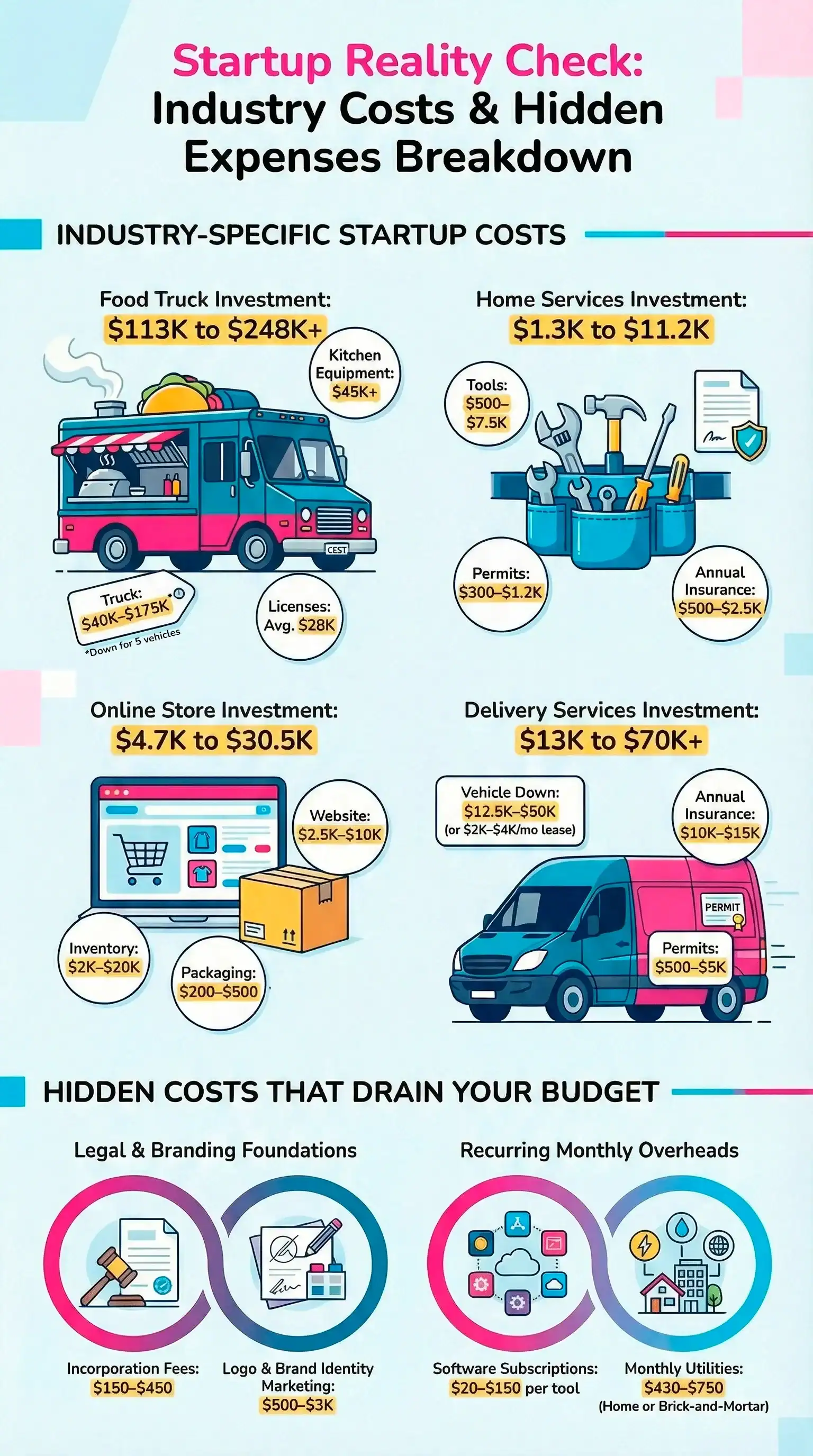
On average, small business owners spend around $40,000 in their first year. Still, that number can change depending on the industry, your location, and how many employees you have.
Food Trucks
Food trucks are a popular business model, but they come with a hefty price tag, starting from the food truck itself. You’ll need to budget for:
- Truck Purchase: The cost of purchasing a food truck can range from $40,000 to $175,000, depending on whether you buy new or used. However, it can also exceed $200,000 if you opt for a customized new vehicle.
- Equipment: Expect to spend approximately $45,000 or more on equipment, including cooking equipment, refrigeration, and other essential kitchen supplies, such as serveware.
- Permits & Licenses: According to Food Truck Nation, food truck owners spend around $28,000 in the first year just on licenses and permits, which may include a food service license, health permit, seller’s permit, parking permit, and food truck permit. However, these costs are only an average, and they can vary depending on where you plan to operate. It’s best to check with local authorities for a precise estimate before setting your budget.
Home Services
From plumbers to landscapers, home services businesses have their own unique cost structure. Initial investments include:
- Tools & Equipment: For trades like plumbing or carpentry, tools are essential. Basic tools can cost anywhere from $500 to $3,000, depending on your trade. If you’re looking for specialized tools, it can cost more than a few hundred dollars. For example, lawn care equipment can cost between $2,900 and $7,550, while pool cleaning equipment typically ranges from $500 to $3,000.
- Licenses & Permits: Depending on the nature of your business and location, you’ll need the appropriate permits. This can range from $300 to $1,200 or more, depending on the type of home service business you operate.
- Insurance: General liability insurance and workers’ compensation are a must for any service-based business. These policies can cost between $500 and $2,500 per year or more.
Online Store
The online store business has grown exponentially, but so has its cost structure. Even if you’re starting small, you’ll need to consider:
- Website Development: While platforms like Shopify or Wix offer affordable options, you might need a professional design if you want to stand out. Expect to pay anywhere from $2,500 to $10,000, depending on the complexity and level of customization.
- Inventory: Whether you’re dropshipping or holding your own inventory, you’ll need to budget for stock, which could cost anywhere from $2,000 to $20,000.
- Shipping & Packaging: Packaging materials, shipping fees, and logistics can add up. That said, plan on spending at least $200 to $500 to get started.
Delivery Services
Interested in starting your own courier business? The delivery service sector incurs numerous startup and monthly costs that every entrepreneur should prepare for. Here’s what to expect as you build out your operation:
- Vehicle Acquisition: If you plan to launch with a fleet (for instance, five vans), expect your initial down payment to land between $12,500 and $50,000. Monthly lease payments typically run $2,000 to $4,000 for a midsize setup.
- Business Licenses & Permits: Securing the right documentation costs $500 to $5,000 upfront, with additional annual renewal fees depending on your region and delivery area.
- Insurance Coverage: Insurance is non-negotiable. Coverage for vehicles, drivers, and business liability typically costs $10,000 to $15,000 per year, with monthly premiums ranging from $800 to $1,250 to keep your vehicles and business protected.
The Hidden Costs of Starting a Business

While you may have a clear idea of the upfront costs, many founders overlook or underestimate hidden costs. These are the expenses that can quickly eat into your budget if you’re not careful.
1. Incorporation Fees
Depending on your state and the chosen structure (such as an LLC or corporation), you’ll need to spend between $150 and $450 upfront. This covers filing your articles of incorporation or articles of organization, as well as government fees.
Additionally, specialty businesses such as agriculture or aviation require a federal license. At the same time, retail establishments need sales tax permits and local documentation, which can further increase the cost.
2. Marketing Costs
Many entrepreneurs underestimate the price of launching a strong brand. Even logo design and branding can cost $500 to $3,000, and the price increases if you add banners, business cards, video ads, or hire experts. Remember, while social media provides free visibility, paid campaigns, signs, and consultant fees are inevitable if you want to achieve more traction.
3. Software Subscriptions
From payroll and invoicing to point-of-sale (POS) systems, software costs add up. Basic business tools may cost $20 to $150 per month each, with some POS and accounting software offering entry-level packages for as little as $0 up to $109 per month. Opt for platforms that bundle multiple functions or start with free versions, and upgrade only as your needs grow, keeping costs manageable.
4. Utilities
Operating a brick-and-mortar location or working from home entails ongoing expenses for electricity, gas, water, internet, and phone services. Expect your total monthly bill to range from $430 to $750 or more, split between electricity ($180–$300), gas ($90–$150), water ($100–$200), and internet/phone ($60–$100). If you don’t plan for these bills, they can consume money intended for growth and development.
Common Pitfalls: Underestimating Ongoing Costs
Many entrepreneurs focus too much on their startup costs and fail to plan for the ongoing operational costs. Some of the most common mistakes include:
- Underestimating Cash Flow: It’s easy to assume that sales will start rolling in from day one, but the reality is that it often takes months or even longer to build up a consistent revenue stream. In the meantime, you’ll still need to cover rent, bills, and payroll. Without a healthy cash buffer, even small delays in income can lead to severe financial strain.
- Payroll: If you’re bringing on full-time employees or relying on freelancers and contractors, payroll is often one of the largest ongoing expenses. Beyond salaries, you also need to think about taxes, health benefits, insurance, and any bonuses or commissions. Misjudging this can put pressure on your margins and impact your ability to grow.
- Inventory Management: For product-based small businesses, you’ll need to consider storage, shipping, packaging, and the cost of replenishing stock regularly. Overstocking ties up capital, while understocking can result in lost sales, and striking the right balance requires careful planning and ongoing oversight.
- Equipment Maintenance and Upgrades: From laptops and POS systems to machinery and delivery vehicles, most businesses depend on equipment that wears down over time. Repairs, software updates, and eventual replacements aren’t optional because they’re part of staying operational and competitive, and budgeting for these recurring costs can save you from sudden disruptions.
- Professional Services: Small businesses may also need ongoing support from accountants, legal advisors, or industry consultants, as these services are essential as you grow, take on new contracts, or navigate regulations. Although it’s tempting to view them as one-off costs, they often become regular line items that are crucial to staying compliant and making informed decisions.
Bootstrapped or Funded: Which is Best for Your Small Business?
Choosing how to finance your small business is one of the most significant decisions you’ll face early on. Do you rely on your own resources and hard work, or do you bring in outside investors willing to share ownership?
What is Equity Funding?
Equity funding means raising capital by giving investors a share of ownership in your business. This typically comes from angel investors, venture capitalists, or equity crowdfunding platforms. Instead of paying back a loan with interest, you offer a portion of your profits and say in decisions in exchange for upfront cash.
Pros of Equity Funding
- No Repayment Pressure: Unlike debt, you don’t have monthly loan payments eating into cash flow.
- Access to Expertise: Investors often bring valuable industry experience, networks, and mentorship.
- Bigger Capital Amounts: Equity investors tend to provide more significant funding to push growth.
Cons of Equity Funding
- Loss of Control: Giving up ownership means sharing decision-making and profit.
- Long, Complex Process: Raising equity involves pitches, negotiations, and due diligence that can delay your timeline.
- Pressure to Grow Fast: Investors expect growth and returns, which can create added stress.
What is Bootstrapping?
Bootstrapping is self-funding your business using personal savings, credit, or cash flow generated by the business itself. It means building your operation lean, relying heavily on your own efforts without external investors.
Pros of Bootstrapping
- Full Ownership and Control: No one else has a say in your business decisions or profits.
- Encourages Discipline: Limited funds push you to prioritize essentials, stay frugal, and think creatively.
- Slower But Stable Growth: You grow at a sustainable pace that fits your resources.
Cons of Bootstrapping
- Limited Capital: Growth may be slower due to cash constraints.
- Higher Personal Financial Risk: You’re often using your own money, credit cards, or assets.
- Potential Missed Opportunities: Without outside cash, you might struggle to seize faster growth chances or bigger contracts.
Both equity funding and bootstrapping have merits and challenges. The right choice depends on your business type, how fast you want to scale, and your willingness to share control. Many entrepreneurs blend both methods, such as bootstrapping early on, then seeking investors once they’ve proven their concept.
The Growing Role of Cash Advances & Microloans in Early Funding
One of the significant challenges new business owners face is securing funding. Traditional bank loans can be difficult to obtain, particularly for newer businesses with limited credit histories.
According to the 10,000 Small Businesses Voices survey by Goldman Sachs, nearly a third of small business owners who’ve tried to secure a new business loan in the past year have run into a wall. The survey findings paint a challenging picture:
- 70% say it’s tough to access affordable funding right now, up from just 61% in April.
- 76% report that limited access to capital is directly affecting their ability to operate and grow.
- 73% report that higher interest rates are making it even harder to maintain a solid financial footing for their business.
Fortunately, traditional loans aren’t the only choice for small business owners. There are also alternative funding options, such as merchant cash advances, lines of credit, inventory financing, and microloans, that enable entrepreneurs to access smaller amounts of capital without the hurdles associated with traditional loans.
Based on the 2024 Small Business Credit Survey (SBCS) data, about 37% of small business owners applied for a loan, line of credit, or merchant cash advance in 2023, holding steady compared to pre-pandemic levels.
The findings suggest that many are turning to online funding platforms, believing these platforms offer faster approvals and easier access to funding compared to traditional banks. This shift reflects the ongoing quest for capital that can be secured quickly to keep businesses moving forward.
The Importance of Realistic Financial Planning

Before you take the leap into entrepreneurship, it’s crucial to create a realistic financial plan. This is the foundation of your business and can make the difference between success and failure.
Many great ideas have fallen apart simply because the numbers weren’t considered carefully enough from the start. A clear financial plan helps you understand how much money you need, where it’s going, and how long your business can survive before turning a profit. It also keeps you accountable and focused as you navigate the ups and downs of running a business.
1. Building a Financial Forecast
Your financial forecast serves as a roadmap, outlining how your business will operate financially over time. A well-rounded forecast should include:
- Startup Costs: Outline every upfront cost you’ll incur before launch. This might include licenses and permits, equipment, website development, branding, inventory, initial marketing campaigns, and any professional fees.
- Operating Expenses: Once you’re up and running, you’ll have regular monthly costs. Think rent, utilities, salaries, insurance, internet, software subscriptions, marketing, and more. Be realistic and when in doubt, overestimate. It’s better to be pleasantly surprised than caught short.
- Revenue Projections: Estimate how much you expect to earn each month, based on market research and realistic sales goals. Avoid overly optimistic figures, as this is where many entrepreneurs set themselves up for disappointment. Start conservative and revise as you go.
- Break-Even Point: Identify the point at which your revenue will start to cover all of your expenses. Knowing when your business is expected to become profitable helps you make smarter decisions about spending, pricing, and growth.
- Profit Margins: Understand your profit margins from the beginning, both gross and net. This allows you to set appropriate pricing and avoid selling yourself short.
Following the 50-30-20 Rule
Just like for personal finances, a helpful budgeting guideline many entrepreneurs can use is the 50-30-20 rule. It’s a simple way to allocate your revenue wisely and build financial discipline into your operations from day one:
- 50% for Essential Costs: This includes rent, utilities, core tools, supplies, and the services necessary to keep the business running on a day-to-day basis.
- 30% for Business Growth: Marketing, product development, hiring, training, and technology upgrades all fall here. Investing in growth is what moves your business forward, but it needs to be done strategically, not impulsively.
- 20% for Emergencies and Savings: Unexpected costs are inevitable, such as equipment failures, slow sales periods, or sudden regulatory changes. This category serves as your financial cushion, providing you with breathing room when things don’t go as planned.
Additional Tips for Smarter Financial Planning
- Track Everything: Use simple accounting software or even a spreadsheet to track every dollar in and out. What you measure, you can manage.
- Separate Personal and Business Finances: Set up a dedicated business bank account and credit card. It’ll simplify your accounting and taxes, and help build business credit.
- Review Regularly: Don’t just set your budget and forget it. Revisit your financials monthly to see what’s working, where you’re overspending, and where you can cut back or reinvest.
- Seek Advice Early: Working with a bookkeeper or financial advisor, even on a part-time or freelance basis, can save you money in the long run by helping you make smarter financial decisions upfront.
How Technology & Innovation Are Shaping Costs for Entrepreneurs in 2025
In 2025, technology has changed the game for entrepreneurs. Advances in artificial intelligence (AI), automation, and e-commerce platforms are reducing some startup costs, particularly in areas such as marketing, customer support, and sales.
For instance, AI-powered tools for marketing and sales can replace the need for expensive agencies. On the other hand, e-commerce platforms like Shopify and WooCommerce offer easy-to-use solutions for retail businesses, slashing the need for costly web developers.
However, relying too heavily on tech can create overdependence on external providers, which may introduce vulnerabilities if those platforms change pricing, policies, or availability.
Setting Yourself Up for Success
Starting a small business in 2025 comes with many costs, some of which are hidden or underestimated. However, with realistic financial planning, thorough research into industry-specific expenses, and a clear understanding of cash flow, entrepreneurs can achieve success. It all boils down to one key factor: preparation.
If you can plan your budget carefully, expect the unexpected, and manage your funds properly, you’ll be ready to take on the challenge of building your business. The journey isn’t easy, but with proper financial planning, you can make a thriving business that lasts.
Disclaimer: Giggle Finance provides Revenue-Based Financing programs for business purposes only. Any mention of any loan product(s), consumer product(s), or other forms of financing is solely for marketing and educational content purposes and to help distinguish Giggle Finance’s product from other comparable financing options available in the markets.