Giggle Finance vs Quickie: Requirements, Cost and Who Each One Approves
Both Giggle Finance and Quickie do the same basic thing: they buy a slice of your future business revenue and advance you the cash now. Neither is a loan. Both run a soft credit check only, both can fund the same day, and both repay weekly out of your sales. If you are choosing between them, the difference that matters is not the product — it is who each one will actually approve.
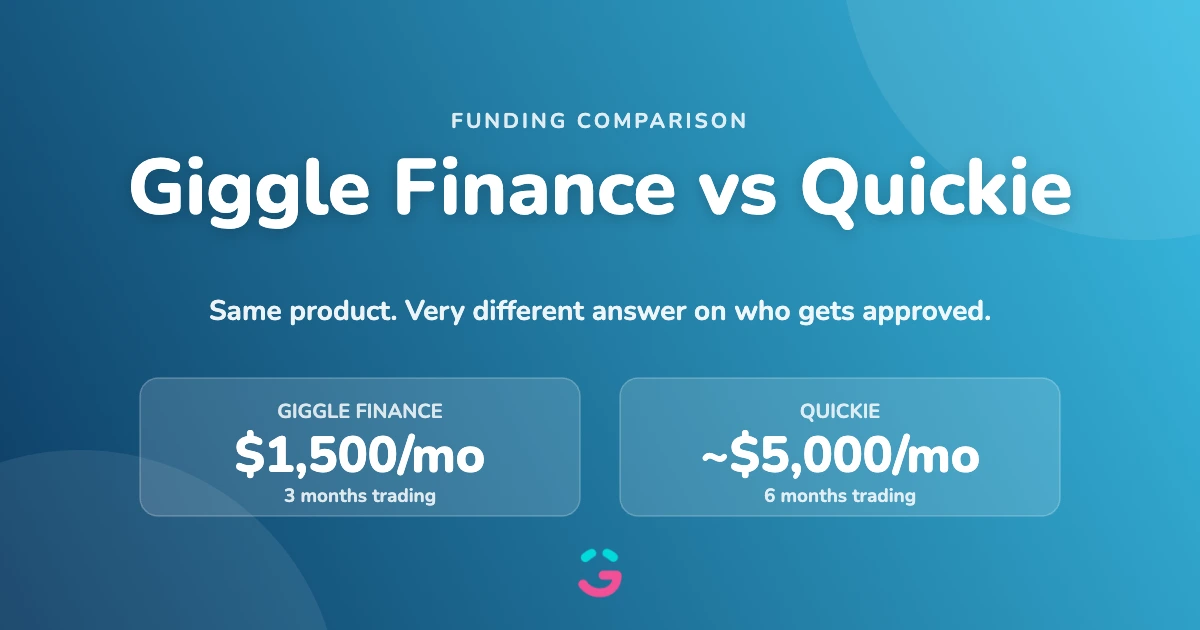
Quickie asks for around $5,000 a month in revenue and six months in business. Giggle Finance asks for $2,500 a month and three months. That is a revenue floor more than three times apart, and it decides the question for most people before anything else does.
| Giggle Finance | Quickie | |
|---|---|---|
| Minimum monthly revenue | $2,500 | Around $5,000; limited exceptions at $3,000–$4,999 |
| Minimum time in business | 3 months | 6 months; limited 4–5 month exceptions, smaller amounts only |
| Funding range | Up to $15,000 new; up to $20,000 returning | $1,000 – $25,000; higher for repeat customers |
| Credit check | Soft pull only, no minimum score | Soft credit check only |
| Business structure | Sole proprietors and 1099 earners — no LLC or EIN required | US business with an EIN, or self-employed 1099 |
| Cost | One flat fee, shown in full before you accept | Factor rate 1.38–1.46 over roughly 16–22 weeks, plus a 7.5% origination fee deducted from the funded amount |
| Repayment | Weekly, as a percentage of revenue | Weekly ACH sized to sales, typically each Friday |
| Early payoff | Discount if repaid within 30 days | Discounted payoff if settled within 60 days |
| Builds business credit | Yes — reports to Experian and TransUnion | Not addressed in the published FAQ |
| Speed | Decision in minutes, same-day funding including weekends | Decision in minutes, same-day funding on qualified files |
Quickie figures above are taken from tryquickie.com’s own homepage and FAQ as published on 15 September 2026. Providers change their terms; check both sites before you apply.
Check what your deposits qualify you for →
The short answer
If you earn $5,000 a month or more and have been trading over six months, both will look at you. Compare the total payback figure each one puts in front of you and take the cheaper offer. Quickie’s ceiling is higher, so if you need more than $20,000 it is the one that can reach it.
If you earn between $2,500 and $5,000 a month, or you have been going less than six months, Giggle is built for you and Quickie’s published requirements are not. A driver clearing $2,400 a month, a barber four months into a chair rental, a seller with three months of Shopify deposits — all sit below Quickie’s stated floor, including its exception band, and all clear Giggle’s.
If you have no LLC and no EIN, Giggle takes sole proprietors and individual 1099 earners as they are. Quickie describes itself as built for registered US businesses, though its stated eligibility also covers self-employed 1099 earners.
What Quickie is
Quickie Business Services LLC offers what it calls business funding through the purchase of future receivables — a commercial transaction rather than a consumer loan. Offers run from $1,000 to $25,000, with repeat customers in good standing able to qualify for more over time. It is aimed at registered US businesses, and its own marketing names salons, food trucks, contractors, online shops, creators and freelancers.
The application runs on a soft credit check only, a decision comes back in minutes, and qualified files can fund the same day. Repayment is an automatic weekly ACH sized to your sales, usually collected on a Friday, until the balance clears.
Credit where it is due: Quickie publishes its pricing openly, which is rarer in this market than it should be. Its FAQ states a factor rate of 1.38 to 1.46 over roughly 16 to 22 weeks, plus a 7.5% origination fee deducted from the funded amount. Knowing that before you apply is genuinely useful, and it lets you do the arithmetic yourself.
Worth understanding what an origination deduction means in practice: it comes out of the money you receive, not the money you repay. On a $10,000 advance, 7.5% is $750, so $9,250 reaches your account while the payback is calculated on the full $10,000. That is normal in this market and Quickie is upfront about it — just factor it in when you compare the figure you need against the figure you get.
What Giggle Finance is
Giggle Finance provides revenue-based financing to self-employed earners and micro-businesses: up to $15,000 for new customers and up to $20,000 for returning customers in good standing. Approval runs on your bank deposits rather than a credit score, with a soft pull that leaves no mark on your report and no minimum score to clear.
You connect your bank instead of uploading statements or tax returns. Repayment is weekly and calculated as a percentage of revenue, so it falls in a slow week rather than landing as a fixed bill. Advances repaid within 30 days qualify for a discount, and on-time payments are reported to Experian and TransUnion, which builds the business credit profile you will need when you outgrow this size of funding.
The requirements are three months of business income, $2,500 a month in deposits across all your income sources, and a US bank account. No LLC, no EIN, no collateral, no business plan. If your credit is the obstacle rather than your income, funding for the self-employed with bad credit covers how that is assessed.
The qualification gap, in real numbers
This is where the two part company, and it is worth being concrete about it.
| Your situation | Giggle Finance | Quickie |
|---|---|---|
| $1,800/month, 4 months trading | Qualifies | Below stated minimum |
| $3,200/month, 5 months trading | Qualifies | Exception band only, smaller amounts |
| $6,000/month, 8 months trading | Qualifies | Qualifies |
| $12,000/month, 2 years trading, needs $24,000 | Above Giggle’s ceiling | Qualifies |
Read that table honestly and it tells you something simple: these two products serve different sizes of business. Quickie is built for an established small business with real monthly volume. Giggle is built for the layer underneath — the driver, the freelancer, the one-chair salon, the seller three months in. Where the bands overlap, compare offers. Where they do not, the choice is made for you.
Where Quickie is the better call
There is no point pretending otherwise, and knowing this saves you an application:
- You need more than $20,000. Giggle caps at $15,000 for new customers and $20,000 for returning ones. Quickie reaches $25,000 and higher for repeat customers.
- You want a longer early-payoff window. Quickie discounts settlements made within 60 days. Giggle’s discount window is 30 days.
- You want the pricing before you apply. Quickie publishes its factor range and origination fee. Giggle discloses your full cost before you accept an offer, but does not publish rates in advance.
Where Giggle is the better call
- You earn under $5,000 a month. This is the big one. Giggle’s floor is $1,500; Quickie’s is around $5,000 with limited exceptions down to $3,000.
- You have been trading under six months. Three months of income is enough for Giggle.
- You have no LLC or EIN. Sole proprietors and individual 1099 earners qualify as they are.
- You want the funding to build your business credit. Giggle reports on-time repayments to Experian and TransUnion. Quickie’s published FAQ does not address credit reporting either way.
- You need money at the weekend. Giggle funds seven days a week.
- Your income comes from several platforms at once. Deposits are assessed in total, so DoorDash, Instacart and client invoices all count toward the same $1,500.
What they have in common
Plenty, and it is worth saying so rather than inventing differences that are not there. Both are revenue purchases rather than loans, which is why neither carries an APR or a fixed monthly payment. Both run soft credit checks that do not mark your report. Both decide in minutes and can fund the same day. Both repay weekly by ACH against your sales. Both show you a total payback figure before you commit.
If you are new to this structure entirely, how revenue-based financing works explains the mechanics that apply to both.
How to compare any two offers
Whoever you end up applying to, three numbers decide whether an offer is good:
- The total payback amount. Not the advance, not the weekly payment. The single figure you will have paid when it is finished. A factor rate of 1.42 on $10,000 means $14,200 back.
- The amount that actually lands. An origination fee comes out of what you receive. Approved for $10,000 at 7.5% origination means $9,250 in the account. If you need $10,000 in hand, you need to be approved for more.
- What happens in a bad week. A payment calculated as a percentage of revenue falls when revenue falls. A fixed debit does not, and that is what turns a slow fortnight into a problem.
Comparing more than two options? See our full list of Giggle Finance alternatives, including Fundo and Ualett.
Frequently asked questions
What does Quickie require to qualify?
Per its published FAQ: around $5,000 in average monthly revenue, with limited exceptions between $3,000 and $4,999; six or more months in business, with limited 4–5 month exceptions qualifying only for smaller amounts; a US business with an EIN or self-employed 1099 status; an active bank account; and an owner aged 18 or over based in the US.
How much does Quickie cost?
Quickie’s FAQ states a factor rate of 1.38 to 1.46 over roughly 16 to 22 weeks, plus a 7.5% origination fee deducted from the funded amount. A 1.42 factor on a $10,000 advance means $14,200 repaid, with $9,250 reaching your account after origination.
Is Quickie a loan?
No. Quickie describes its product as the purchase of future receivables — a commercial transaction rather than a consumer loan. Giggle Finance’s revenue-based financing works on the same principle. Neither carries an APR or a fixed monthly payment.
What is the best Quickie alternative for smaller earners?
If you are under Quickie’s revenue floor, Giggle Finance is the closest equivalent that will consider you: the same soft-pull, same-day, weekly-repayment structure, but with a $1,500 monthly minimum and a three-month trading requirement.
Does Quickie check your credit?
Quickie states it runs a soft credit check only, and that your score is not affected whether or not you take the funding. Giggle Finance also uses a soft pull only, with no minimum credit score.
Which is faster, Giggle or Quickie?
Both give a decision in minutes and can fund the same day. Giggle funds seven days a week including weekends; Quickie states same-day funding on qualified files.
Can I use both?
Taking overlapping advances from two providers at once stacks two weekly obligations against one revenue stream, and it is how manageable funding becomes unmanageable. Clear one before taking another.
How much can I get from Giggle Finance?
Up to $15,000 as a new customer and up to $20,000 as a returning customer in good standing. The amount depends on how much you deposit each month and how consistent it is.
Check which one you qualify for
The fastest way to settle this is to find out where your deposits actually land. If you have three months of business income and $2,500 or more a month coming in, you can see your Giggle offer without touching your credit score. It takes a few minutes, there is no paperwork, and it runs around the clock.
Disclaimer: Giggle Finance provides Revenue-Based Financing programs for business purposes only. Any mention of any loan product(s), consumer product(s), or other forms of financing is solely for marketing and educational content purposes and to help distinguish Giggle Finance’s product from other comparable financing options available in the market. Quickie is a trademark of Quickie Business Services LLC and is used here for identification and comparison only; Giggle Finance is not affiliated with, endorsed by or sponsored by Quickie. All Quickie figures are drawn from publicly published information on tryquickie.com as at 15 September 2026 and may change without notice. Verify current terms with each provider before applying.